Best Portable Nail Drill for Sensitive Skin, Low-Heat

Five portable nail drills compared on the specs that actually matter for tender cuticles: speed ceiling, body weight, grip diameter and how much control the dial gives you at the low end.

By Corey DuncanUpdated 16 min read
On this page
- Best portable nail drill for sensitive skin at a glance
- Why does a portable nail drill for sensitive skin need a low speed floor?
- How I matched five drills to five buyer profiles
- 1. MelodySusie USB Nail Drill PC120I for Gentle Nail Prep — Best overall
- 2. COSLUS C40 Electric Nail Drill Professional — Best upgrade
- 3. COSLUS C20 Cordless Nail Drill Electric File: Portable — Best minimal setup
- 4. TUOBEO Cordless Nail Drill Electric Nail File Kit — Best for pros
- 5. Hoxida Cordless Nail Drill 35000RPM — Best premium
- Corded or cordless: which is gentler in practice?
- What the listings do not tell you about sensitive skin
- Grip, weight and the specs worth comparing
- The verdict
- FAQ
The best portable nail drill for sensitive skin is the MelodySusie PC120I, because its speed tops out at 20,000 RPM and the listing puts low heat, low noise and low vibration ahead of raw power. If you want finer control at the slow end, the COSLUS C40 and its dial beat it. Most buyers compare peak RPM first, which is exactly backwards. A 35,000 RPM ceiling tells you nothing about how the tool behaves at 4,000 RPM, and that slow range is where tender cuticles live.
Best portable nail drill for sensitive skin at a glance
| Pick | Top speed | Weight | Price |
|---|---|---|---|
Best overall MelodySusie USB Nail Drill PC120I |
0–20,000 RPM claim | 65-piece kit | Check Price |
Best upgrade COSLUS C40 Electric Nail Drill |
Dial speed control | 6.08 oz | Check Price |
Best minimal setup COSLUS C20 Cordless Nail Drill |
Adjustable, F/R | 3.2 oz | Check Price |
Best for pros TUOBEO Cordless Nail Drill Kit |
0–20,000 RPM claim | 7.83 oz | Check Price |
Best premium Hoxida Cordless Nail Drill 35000RPM |
0–35,000 RPM claim | 2.96 oz | Check Price |


Why does a portable nail drill for sensitive skin need a low speed floor?
Heat is the thing that hurts. A rotating bit generates friction against the nail plate, and that friction conducts straight through to the nail bed and the surrounding skin. The faster the bit spins in one spot, the faster the temperature climbs.
So the number that matters is not the top of the range. It is how finely you can hold the tool near the bottom of it.
Every one of these five listings advertises a range starting at zero. That sounds identical across the set. It is not, because the mechanism differs:
- A single push-button cycling through fixed steps gives you three or five choices and nothing in between. The TUOBEO listing describes 3-speed adjustable settings.
- A continuous dial lets you creep up until the bit bites and stop there. The COSLUS C40 is built around a "precise dial speed control" per its title.
- A five-step selector with a display shows you where you are, which the Hoxida offers with its LCD readout.
None of these five products is marketed as a sensitive-skin device, and no listing here makes a skin claim. What they do publish is low-heat and low-vibration language, plus speed ceilings and weights. That is the evidence you can actually compare, so that is what this guide compares.
Second criterion: vibration. Four of the five listings use the phrase "low heat", and three of them pair it with "low vibration" or "low noise". Those are manufacturer claims rather than measured figures, so treat them as intent rather than proof. What you can verify from the specs is body size, and a thinner barrel in a lighter body means less transmitted buzz through your fingertips over a twenty-minute session.
Third criterion: bit quality. A worn sanding band skids instead of cutting, and skidding means pressure, and pressure means heat. Kit size matters more than it looks.
How I matched five drills to five buyer profiles
I worked profile-first here. Rather than scoring every drill on one scale, I lined up the published specifications side by side and asked which single buyer each one genuinely serves better than the other four.
- The nervous beginner. Needs a hard ceiling, plenty of spare bands, and no decisions to make. The MelodySusie PC120I caps at 20,000 RPM and ships as a 65-piece set.
- The control seeker. Wants to dial in a speed and leave it. The COSLUS C40 puts a dial on a 4.53 x 0.7 x 0.7 in pen body.
- The traveller. Wants the lightest handpiece and the fewest parts. The COSLUS C20 weighs 3.2 oz and is the only pick with a published warranty, at 2 years.
- The volume user. Doing several full sets a week and burning through bands. The TUOBEO arrives with 11 bits and 56 sanding bands per its listing.
- The experienced hand. Wants headroom for acrylic removal. The Hoxida claims 0–35,000 RPM across five steps.
What got cut in the process: anything where the published spec sheet was too thin to compare, and anything whose only differentiator was the accessory count. Two picks here sit in the entry price positions, one is roughly mid-range for this set, and two sit at the premium end. Price position tracked runtime and top speed far more closely than it tracked control quality, which is worth knowing before you spend up.
1. MelodySusie USB Nail Drill PC120I for Gentle Nail Prep — Best overall
The PC120I wins because it pairs a 20,000 RPM ceiling with the largest accessory kit here, which is the combination that keeps a beginner from pressing too hard.
Best for: beginners who want a big bit set and a hard 20,000 RPM ceiling Skip it if: you need to work away from an outlet
Within this set, the PC120I is the pick that removes the temptation to over-spec. Its published range is 0–20,000 RPM, matching the TUOBEO and sitting well below the Hoxida's 35,000 RPM claim. For anyone worried about tender cuticles, a lower maximum is a feature, not a compromise.
The kit is the other reason it leads. At 65 pieces it is the deepest accessory set of the five, and it includes 3/32" metal bits per the listing, which is the standard shank size across most replacement bands you'll find. Fresh bands cut instead of skidding, and a deep kit means you replace them before they glaze over.
MelodySusie describes a quiet motor with smart heat dissipation, keeping the machine at low heat, low noise and low vibration. That is the brand's claim rather than a measured figure. Speed is adjustable in both forward and reverse, which the listing notes suits right-handed or left-handed use.
The trade-off is the cord. This is a USB-powered unit at 3.15 x 8.66 x 3.94 in with a base, not a self-contained handpiece, so you are tethered to a port and working within reach of it. It also sells more slowly than the two COSLUS units in this group.
Pros:
- 20,000 RPM ceiling, the safer half of this set
- 65-piece kit, deepest accessory count here
- Standard 3/32" bit shank per the listing
- Forward and reverse for either hand
- The cheapest of the five
Cons:
- Corded USB operation, no battery
- Largest footprint here at 8.66 in long
- No published weight for the handpiece
- No stated warranty, unlike the COSLUS C20
2. COSLUS C40 Electric Nail Drill Professional — Best upgrade
The C40 is the one to buy if you want continuous speed control rather than fixed steps, in the thinnest body of the five.

Best for: anyone who wants fine dial control in a pen-thin body Skip it if: you want cordless freedom
The C40's title leads with "precise dial speed control", and in this set that is the meaningful difference. A dial lets you nudge the speed up a fraction at a time until the bit begins to cut, then stop. Fixed steps make you jump past that point and back off with pressure instead, which is where heat builds.
The body is 4.53 x 0.7 x 0.7 in and weighs 6.08 oz. That 0.7 in barrel is the narrowest here, which means a true pencil grip, and a pencil grip is what gives you the fine wrist angles that keep a bit off the cuticle line. COSLUS calls the pen shape easy for beginners to hold and control.
Six bits ship in the box, and COSLUS says the tool handles acrylic, gel and dip powder removal along with polishing. The brand also lists low noise and low heat, again as a claim rather than a measurement.
This unit sells faster than any other pick here, which tells you something about how the wider market rates the pen format. The trade-off is the tether and the small kit: six bits against 65 on the MelodySusie, so you'll be buying replacement bands sooner.
Pros:
- Continuous dial control instead of fixed steps
- Narrowest barrel in this set at 0.7 in
- 6.08 oz, lighter than the TUOBEO
- The one buyers choose most often here
- Second-cheapest of the five
Cons:
- Corded, so no untethered use
- Only 6 bits, against 65 on the MelodySusie
- No published top speed figure in the specs
- No stated warranty
3. COSLUS C20 Cordless Nail Drill Electric File: Portable — Best minimal setup
The C20 is the lightest handpiece here at 3.2 oz and the only pick in this comparison with a published warranty.
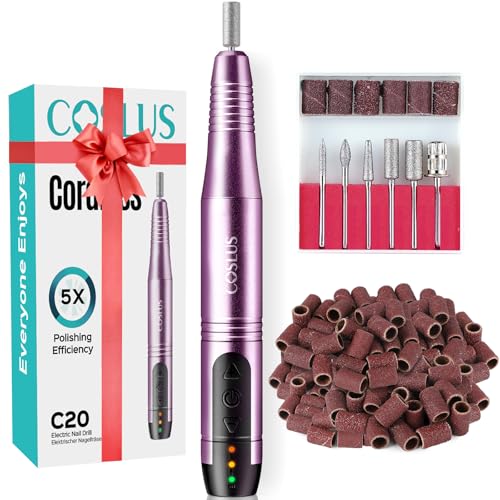
Best for: travellers who want a warranty and the lightest handpiece here Skip it if: you want the largest accessory kit
Weight is the quiet variable in a portable nail drill for sensitive skin. Hold a heavy handpiece for twenty minutes and your grip tightens, and a tightened grip presses harder. At 3.2 oz the C20 sits second-lightest by the weight spec and the brand quotes it at 0.2 lbs in its own copy.
It is also the only one of the five with a warranty on the listing, at 2 years. Across a set where four brands publish nothing, that single line is the clearest signal of what a manufacturer expects its motor to survive.
Cordless operation matters more than convenience suggests. No trailing cable means no drag pulling your hand off the angle you set, which is exactly the sort of small correction that ends in a nicked cuticle. COSLUS says the C20 can run while charging and cites an upgraded motor with overload protection.
Speed is adjustable with forward and reverse, though no peak RPM figure appears in the specifications. The body measures 6.22 x 3.27 x 1.57 in as packaged. Against the MelodySusie, you give up a 65-piece kit for the freedom of the battery, and against the C40 you lose the dial.
Pros:
- 3.2 oz handpiece, near the lightest here
- 2-year warranty, the only one in this set
- Cordless with use-while-charging per the listing
- Forward and reverse direction control
Cons:
- No published top speed in the specs
- Smaller kit than the MelodySusie or TUOBEO
- Slowest seller of the three cheapest picks
- Battery adds a failure point a corded unit does not have
4. TUOBEO Cordless Nail Drill Electric Nail File Kit — Best for pros
The TUOBEO is the volume choice: 11 bits, 56 sanding bands and a claimed 7 hours of runtime from a 1.5-hour charge.

Best for: heavy users who want 11 bits, 56 bands and a long runtime Skip it if: wrist fatigue is your limiting factor
Sanding bands are consumables, and the number in the box is a real cost. TUOBEO lists 11 drill bits and 56 sanding bands, plus a brush and a dust-proof accessory. That band count is the highest here by a wide margin, and it directly serves the sensitive-skin case: a fresh band cuts cleanly at low speed, while a glazed one needs pressure and generates heat.
Runtime is the other strength. TUOBEO claims a 1.5-hour charge for up to 7 hours of use, the longest quoted figure in this group, beating the Hoxida's stated 6 hours from a 2-hour top-up.
The motor is quoted at 20,000 RPM with adjustable control from zero, and TUOBEO describes the design as low vibration, low heat and ergonomic. Speed is set across 3 adjustable settings per the listing, which is coarser than the C40's dial.
At 7.83 oz this is the heaviest pick of the five, more than double the C20. Over a long session that extra mass tells in your wrist, and a tired wrist presses harder than a fresh one. It is also the only pick here where more than one seller lists it, with two offers, and it sits at the premium end of this set.
Pros:
- 56 sanding bands, most in this set
- 11 drill bits for varied prep and removal
- Claimed 7-hour runtime from a 1.5-hour charge
- 20,000 RPM ceiling rather than 35,000
Cons:
- Heaviest handpiece here at 7.83 oz
- Only 3 fixed speed settings, no dial
- No published dimensions in the specs
- Premium price position with no stated warranty
5. Hoxida Cordless Nail Drill 35000RPM — Best premium
The Hoxida is the only pick that goes above 20,000 RPM, and that headroom is a reason for experienced users to buy it and everyone else to avoid it.

Best for: experienced users who want headroom above 20,000 RPM Skip it if: you have never used an e-file before
Hoxida quotes 0–35,000 RPM across 5 adjustable speeds with forward and reverse, and an aluminium alloy motor with a ventilation system. On paper it is the most capable machine here. In practice, that ceiling is the thing to think hardest about if your skin reacts easily, because the gap between "cutting" and "burning" narrows as speed climbs.
The LCD display is the offsetting feature. Being able to read your speed rather than count button presses is genuinely useful when you want to return to the same gentle setting session after session, and no other pick here shows you a number.
It is also the lightest of the five at 2.96 oz, in a 0.81 x 6.48 x 0.81 in body, which is a slim barrel close to the C40's. Hoxida claims a 2-hour Type-C charge for up to 6 hours of continuous use.
Two things count against it. It is the most expensive pick here, and it is the slowest seller of the five by a large margin. It also publishes no warranty, which is hard to justify at the top of this price range when the far cheaper COSLUS C20 lists 2 years.
Pros:
- Lightest pick here at 2.96 oz
- LCD display shows the exact speed setting
- 2-hour Type-C charge, claimed 6-hour runtime
- Slim 0.81 in barrel for a pencil grip
Cons:
- 35,000 RPM ceiling is a burn risk for beginners
- Most expensive pick with no published warranty
- Slowest seller of the five by a wide margin
- Only one seller lists it
Corded or cordless: which is gentler in practice?
Corded and cordless split this set two to three, and the answer depends on where you sit.
If you do your nails at the same desk every time, corded wins. The MelodySusie PC120I and the COSLUS C40 draw constant power, so the speed you set is the speed you get from the first minute to the last. A battery pack under load can sag, and a sagging speed makes you push harder to compensate.
If you work in more than one place, cordless wins on cable drag. The COSLUS C20, TUOBEO and Hoxida all run untethered. A cord tugging at your wrist pulls the bit off angle by small amounts, and small angle errors near the cuticle are the ones that catch skin.
The cutoff is session length. Under about fifteen minutes, either format is fine. Beyond that, the published runtimes start to matter: TUOBEO quotes up to 7 hours and Hoxida up to 6, which comfortably covers a full set either way.
Weight follows the same split. The corded picks put the motor in the base or accept a chunkier barrel, while the cordless picks carry the battery in your hand. That is why the C20 at 3.2 oz and the Hoxida at 2.96 oz are impressive numbers, and why the TUOBEO at 7.83 oz asks something of your wrist.
What the listings do not tell you about sensitive skin
Here is the honest position. None of these five products is sold as a sensitive-skin tool, and Amazon's results for this search do not filter for that. So no drill here can be said to meet that requirement, and any guide that claims otherwise is inventing a specification.
What the listings do not publish:
- A measured heat figure. Four brands write "low heat" and none of them attach a number or a test condition.
- A decibel rating. "Low noise" appears repeatedly with nothing behind it.
- A vibration measurement. Same story.
- Bit material grades. MelodySusie names a 3/32" shank, which is useful; grit numbers are absent across the board.
- A minimum stable RPM. Every range starts at zero, which tells you nothing about the slowest speed the motor holds without stalling.
So judge it yourself, on the things you can check. Set the lowest speed that visibly removes material and stop there. Keep the bit moving continuously rather than dwelling in one spot. Change sanding bands well before they stop cutting. Work on the nail plate and treat the cuticle as a boundary, not a target. If any spot feels warm, lift off immediately and let it cool.
If your skin is genuinely reactive or you have a medical condition affecting your nails or circulation, get advice from a professional before using any rotary tool on yourself. That is not a specification any listing can supply.
Grip, weight and the specs worth comparing
If you shop beyond these five, these are the figures worth lining up. Every one of them appears somewhere in the specs above, which means you can compare a new listing against this set directly.
- Barrel diameter. Under about 0.8 in gives you a pencil grip. The C40 sits at 0.7 in, the Hoxida at 0.81 in.
- Handpiece weight. Under 4 oz is comfortable for long sessions. The C20 is 3.2 oz, the Hoxida 2.96 oz, the TUOBEO 7.83 oz.
- Speed ceiling. A 20,000 RPM cap is plenty for gel and dip prep. Only the Hoxida exceeds it here.
- Control type. A dial beats fixed steps. A display beats guessing.
- Band count in the box. 56 bands on the TUOBEO versus 6 bits on the C40 is a two-year gap in replacement buying.
- Warranty. Two years on the C20 is the only published figure in this set, so treat it as the benchmark rather than the norm.
Notice what is missing from that list: brand names, marketing adjectives and anything about how the tool looks. Colour is published for all five, from A-gold to rose gold to two shades of purple, and it decides nothing.
The verdict
If you are new to e-filing and your skin flares easily, buy the MelodySusie PC120I. Its 20,000 RPM ceiling keeps you out of the speed range where burns happen, the 65-piece kit means you always have a fresh band, and it is the cheapest pick of the five. The cord is the price of that, and at a fixed desk it costs you nothing.
If you already know how to hold an e-file and want better control, buy the COSLUS C40. The dial is its exact advantage over the winner: continuous adjustment instead of preset jumps, in a 0.7 in barrel at 6.08 oz. That combination is what lets you find the slowest speed that still cuts, which is the whole technique.
The cutoff is experience. Under a few months of practice, the ceiling matters more than the control, so the MelodySusie is the safer default. Past that, the control matters more than the ceiling, and the C40 takes over.
Two conditions flip both answers. If you need to work away from an outlet, the COSLUS C20 gives you 3.2 oz cordless with a 2-year warranty. If you get through sanding bands weekly, the TUOBEO's 56 bands and claimed 7-hour runtime make it the cheaper choice over a year, provided your wrist tolerates 7.83 oz.
FAQ
What is the best portable nail drill for sensitive skin overall?
The best portable nail drill for sensitive skin overall is the MelodySusie PC120I. Its speed range stops at 20,000 RPM rather than climbing to 35,000, which removes the setting most likely to overheat a nail plate. The 65-piece kit also means fresh sanding bands are always on hand, and a fresh band cuts at low speed instead of needing pressure.
Is a premium nail drill worth it for gentle nail prep?
Is a premium nail drill worth it? Only for the runtime and the display. The Hoxida is the most expensive pick here and offers an LCD readout, 2.96 oz weight and a claimed 6-hour battery. But its 35,000 RPM ceiling is capability you should not use on tender skin, and it publishes no warranty. The cheapest pick handles gentle prep just as well.
How many RPM does a portable nail drill for sensitive skin need?
A portable nail drill for sensitive skin needs far less speed than the marketing suggests. Four of these five picks cap at or below 20,000 RPM, and that range covers gel, dip powder and general shaping. What matters more is how finely you can adjust the low end. A continuous dial beats three fixed steps every time.
COSLUS C40 or COSLUS C20: which should I choose?
Between the COSLUS C40 and C20, choose on power source. The C40 is corded with a precise dial and a 0.7 in barrel at 6.08 oz, so it wins on fine control at a fixed desk. The C20 is cordless at 3.2 oz with a 2-year warranty, the only published warranty here, and it wins if you move around.
What mistake do first-time nail drill buyers make?
The mistake first-time nail drill buyers make is chasing peak RPM. A 35,000 RPM figure looks like value and behaves like a hazard on thin nails. The second mistake is running sanding bands until they stop cutting, then pressing harder. Pressure creates heat, and heat is what makes the skin around your nails sting for hours afterwards.
Start with the MelodySusie PC120I on the lowest setting that visibly removes material, and keep the bit moving. That single habit does more for sensitive skin than any spec on any listing. Change your sanding band the moment it starts skidding rather than cutting, and stop the second a nail feels warm. If you find yourself wanting finer adjustment after a few months, the COSLUS C40's dial is the upgrade that will actually change how your sessions feel. Buy the tool that limits you first, then earn the one that does not.