Best SPF 50 Sunscreen for Dark Spots: Eucerin Wins

Five SPF 50 face sunscreens ranked for skin already dealing with dark spots, with the deciding specification named and the trade-offs made plain.

By Corey DuncanUpdated 14 min read
On this page
- Best SPF 50 sunscreen for dark spots at a glance
- The deciding factor most dark-spot guides miss
- 1. Eucerin Sun Age Defense Face Sunscreen Lotion SPF 50 — Best overall
- 2. CeraVe Invisible Mineral Sunscreen SPF 50 Face Sunscreen — Best budget pick
- 3. La Roche-Posay Anthelios UV Tone Sunscreen for Face SPF 50 — Best premium
- 4. Paula's Choice 5% Vitamin C Sheer Face Sunscreen SPF 50 — Best minimal setup
- 5. DOMINAS Dark Spot UV Defense Sunscreen SPF 50 — Best for pros
- How I screened this shortlist
- Chemical or mineral: which suits dark-spot skin?
- What actually fades a dark spot?
- How long does a bottle last on daily use?
- Which pick suits your routine?
- The verdict
- FAQ
The best SPF 50 sunscreen for dark spots is Eucerin Sun Age Defense Face Sunscreen Lotion SPF 50, a 2.5 oz pump built around a five-antioxidant formula and hyaluronic acid, dermatologist-developed for daily wear under makeup. If you want a mineral filter for reactive skin, CeraVe Invisible Mineral Sunscreen SPF 50, 1.62 fl oz, is the better pick. This guide ranks five SPF 50 face sunscreens, names the deciding specification, and flags where a claim about dark spots is marketing rather than certainty.
Best SPF 50 sunscreen for dark spots at a glance
| Pick | Size | Filter type | Price |
|---|---|---|---|
Best overall Eucerin Sun Age Defense SPF 50 |
2.5 fl oz | Chemical (oxybenzone/octinoxate-free) | Check Price |
Best budget pick CeraVe Invisible Mineral SPF 50 |
1.62 fl oz | Mineral | Check Price |
Best premium La Roche-Posay Anthelios UV Tone SPF 50 |
1.7 fl oz | Chemical (oxybenzone/octinoxate-free) | Check Price |
Best minimal setup Paula's Choice 5% Vitamin C Sheer SPF 50 |
2 fl oz | Chemical (5% vitamin C claim) | Check Price |
Best for pros DOMINAS Dark Spot UV Defense SPF 50 |
1.7 fl oz | Chemical (niacinamide claim) | Check Price |



The deciding factor most dark-spot guides miss
Most "best SPF 50 sunscreen for dark spots" guides compare added actives: vitamin C, niacinamide, brightening extracts. That is not what decides it. The deciding factor is whether you will actually reapply. Two milligrams per square centimetre of face means roughly a quarter teaspoon each application, twice or three times through a sunny day. A bottle that stings, greys your skin tone or slides off makeup gets used once and forgotten, and dark spots deepen no matter what serum sits underneath.
That is why texture, finish and pump delivery outrank ingredient theatrics for this category. A five-antioxidant chemical filter you apply generously beats a mineral filter with niacinamide you skip after breakfast.
One honest note about the search itself. Amazon's results for the exact phrase "spf 50 sunscreen for dark spots" include products where the dark-spot claim is marketing rather than a measured outcome. I treat those claims here as attributed statements from the listing, not as facts, and I flag the picks where the case for dark spots rests entirely on a bullet point.
1. Eucerin Sun Age Defense Face Sunscreen Lotion SPF 50 — Best overall
A dermatologist-developed daily face SPF with the most published specifications in this set and a pump that makes reapplication realistic.
Best for: daily wear under makeup on combination skin Skip it if: you want a mineral filter or a tint
Eucerin wins on the boring specifications that actually decide a sunscreen. It is the biggest bottle in this set at 2.5 fl oz, versus 1.62 to 2 fl oz for the rest, and it is the second-cheapest of the five. Eucerin says the formula pairs five antioxidants with hyaluronic acid, and the brand positions it as hypoallergenic and non-comedogenic, free of fragrance, dyes, parabens, PABA, phthalates, oxybenzone and octinoxate. That free-from list matters if fragrance and oxybenzone have flared your skin before, which is common in the pigmentation-prone.
The pump dispenser is the quiet win. A pump doses more evenly than a squeeze tube, which pushes daily wearers toward a proper amount rather than a shy pea. The listing calls it invisible and lightweight, and dermatologist-developed for wear under makeup. Sells faster than three of the five here, so restocks are not a problem.
The trade-off: Eucerin does not lean on a single hero brightener like vitamin C or niacinamide. If a listed active is what you want to see, another pick will read more convincingly.
Pros:
- Largest bottle in this set at 2.5 fl oz
- Pump delivery encourages a full dose
- Free of fragrance, oxybenzone and octinoxate
- Dermatologist-developed for under-makeup wear
- Six published specifications, the most in this set
Cons:
- Chemical filter, so not a match for mineral-only routines
- No published tint for warm undertones
- Antioxidant lineup is unnamed on the label copy given
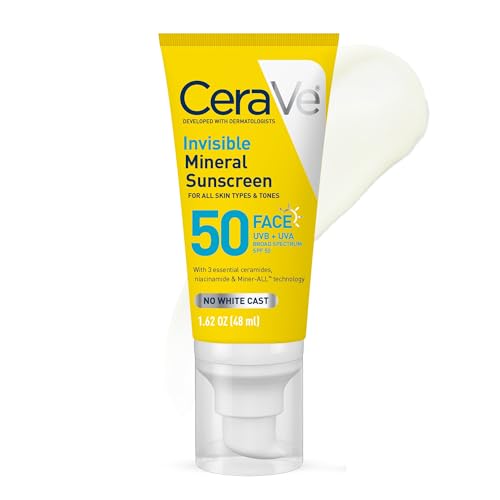
2. CeraVe Invisible Mineral Sunscreen SPF 50 Face Sunscreen — Best budget pick
A fragrance-free mineral SPF 50 with three ceramides, the cheapest of the five and the fastest seller here.
Best for: sensitive or acne-prone skin that reacts to chemical filters Skip it if: you dislike shaking a bottle before every use
CeraVe is the cheapest of the six ingredients you would compare, and it is the one buyers choose most often here by a wide margin. It is also the only mineral filter in the set, which matters if chemical UV filters have irritated your skin or triggered post-inflammatory marks in the past. The listing describes a fragrance-free, non-comedogenic formula suitable for sensitive and acne-prone skin, with three ceramides and CeraVe's Miner-ALL technology for what the brand calls a 100% invisible finish across skin tones.
At 1.62 fl oz it is the smallest bottle here, so a full-face daily user will refill faster than with the 2.5 oz Eucerin. Dimensions are compact at 5.51 x 1.43 x 1.86 in, which suits a work bag. CeraVe says to shake well before use, standard for a mineral fluid but a habit some skip.
The trade-off against Eucerin: CeraVe's dark-spot case is indirect. It prevents new pigmentation with a mineral shield, but nothing in the specifications treats existing spots.
Pros:
- Cheapest pick in this five-product set
- Mineral filter suits sensitive and acne-prone skin
- Fragrance-free with three ceramides
- Lowest sales rank of the five, so easy to restock
- Compact 5.51 in bottle for a bag
Cons:
- Smallest bottle at 1.62 fl oz
- Requires shaking before every application
- No published active targeting existing dark spots
3. La Roche-Posay Anthelios UV Tone Sunscreen for Face SPF 50 — Best premium
A hydrating SPF 50 with a barely-there texture the brand positions for even blending across all skin tones.

Best for: deeper skin tones that need zero white cast Skip it if: you want the most published specifications on the label
Anthelios is the most expensive pick here, and the case for paying more is the finish. La Roche-Posay says the formula delivers SPF 50 without a white cast on all skin types, with a barely-there texture that blends invisibly and leaves what the brand calls a smooth, radiant finish. For medium-to-deep skin, that difference between "invisible" and "cast" is often the reason a bottle gets used daily instead of on beach days only.
The brand also states the formula is oxybenzone-free and octinoxate-free, and helps decrease the risk of skin cancer and early skin aging caused by the sun when used with other sun-protection measures. The bottle is 1.7 fl oz, mid-size for this set, released in 2024.
The trade-off is data thin. La Roche-Posay publishes five specifications here versus Eucerin's six, no dimensions, and the "even skin tone" line for dark spots is a brand claim rather than a named ingredient. You pay for the sensory experience and the pharmacy pedigree.
Pros:
- Positioned for invisible finish on deeper skin tones
- Oxybenzone-free and octinoxate-free
- Mid-size 1.7 fl oz bottle
- 2024 formulation
- Fluid, radiant finish per the listing
Cons:
- Most expensive pick here
- Fewer published specifications than Eucerin
- Dark-spot claim rests on a general "even skin tone" line
4. Paula's Choice 5% Vitamin C Sheer Face Sunscreen SPF 50 — Best minimal setup
A 5% vitamin C claim built into a broad-spectrum SPF 50, so one step covers what many routines split into two.

Best for: someone who wants antioxidants and SPF in one step Skip it if: you already layer a dedicated vitamin C serum
Paula's Choice is the pick if you want fewer bottles on the shelf. The brand says the formula uses three stable forms of vitamin C at a 5% concentration to provide antioxidant defence and visibly brighten the complexion, while delivering broad-spectrum SPF 50. That is the tightest dark-spot pitch in this set, though it remains a manufacturer claim rather than a measured outcome.
The bottle is 2 fl oz, second-largest here, and the finish is described as ultra-sheer with no white cast or greasy residue. Paula's Choice states the formula is fragrance-free and enriched with amino acids to support the skin barrier. It sits in the premium price position, and it is the slowest seller of the five, which usually just means it draws routine-builders rather than impulse buyers.
The trade-off: vitamin C in a sunscreen bottle is convenient but harder to dose than a serum. If you already own a dedicated 10 to 20% L-ascorbic acid serum, you do not need to pay extra for a lower concentration in an SPF.
Pros:
- 5% vitamin C claim built into the SPF step
- Fragrance-free with amino acid support
- 2 fl oz bottle, second-largest here
- Ultra-sheer finish per the listing
- Consolidates two routine steps into one
Cons:
- Slowest seller of the five
- Premium price for a 5% vitamin C concentration
- Only three published specifications
- Redundant if you already use a vitamin C serum
5. DOMINAS Dark Spot UV Defense Sunscreen SPF 50 — Best for pros
A Korean SPF 50 with a niacinamide and panthenol claim, aimed at buyers who already know how to layer actives.

Best for: advanced routines that already include actives Skip it if: you want a well-known brand you can find offline
DOMINAS is the only pick in this set to name dark spots on the label itself. The brand says the 1.7 fl oz formula pairs SPF 50 with niacinamide, panthenol and peony and nutmeg extracts, positioned as a two-in-one for pigmentation and daily sun defence. DOMINAS describes itself as a South Korean brand focused on blemish care since 1985. That positioning matters: if you already use a retinoid or an exfoliating acid, niacinamide slots in as a soothing partner rather than another exfoliant to balance.
Sits mid-range on price for this set. Only one seller lists it beyond the primary listing, and it is the slowest-selling of the five in this category by a wide margin, which means checking availability before you commit to it as a staple.
The trade-off is trust surface. Eucerin, CeraVe and La Roche-Posay have decades of dermatology positioning behind them. DOMINAS is less familiar in Western markets, and the dark-spot copy is not accompanied by a published clinical figure in the listing. Read the ingredient list before you buy.
Pros:
- Names dark spots directly on the label
- Niacinamide and panthenol claim
- Mid-range price for this set
- 1.7 fl oz bottle in a compact 5.77 in body
- Brand focused specifically on blemish care
Cons:
- Least familiar brand in this set
- Slowest seller of the five by category rank
- No published dimensions for two of the four spec fields
- Dark-spot claim rests on marketing copy
How I screened this shortlist
The picks map to five buyer profiles, and each was chosen against a specific screen.
- Dermatologist positioning. The listing has to say the product was developed with or by dermatologists, or come from a brand with a pharmacy pedigree. Eucerin and La Roche-Posay clear that bar outright.
- Finish on medium-to-deep skin. The listing has to state no white cast or an invisible finish across skin tones. All five clear this, but only La Roche-Posay leads with it.
- A published free-from list. Fragrance, oxybenzone and octinoxate are the three most common triggers for reactive skin. Eucerin publishes the longest free-from list here; CeraVe confirms fragrance-free.
- Bottle size against daily use. The 2.5 oz Eucerin and 2 oz Paula's Choice suit real daily wearers; the 1.62 oz CeraVe and 1.7 oz La Roche-Posay and DOMINAS mean more frequent refills.
- Attributable dark-spot claim. Only two picks name pigmentation directly on the label: Paula's Choice through vitamin C, and DOMINAS through niacinamide. Those are the two where the dark-spot pitch stands or falls on the listing copy.
Chemical or mineral: which suits dark-spot skin?
Four of these five picks use chemical filters. One, the CeraVe, is mineral. The chemical-versus-mineral debate matters more for dark-spot-prone skin than most guides admit.
- Chemical filters absorb UV and convert it to heat. On skin already prone to post-inflammatory pigmentation, that small temperature bump has been discussed as a possible trigger, though the evidence is mixed. Chemical formulas are usually thinner, blend invisibly, and layer well under makeup.
- Mineral filters sit on the skin and reflect UV. They tend to be gentler on reactive or acne-prone skin, and they carry no absorption question mark. The trade-off is texture: even the invisible mineral fluids need shaking, and some leave a faint cast on deeper tones despite the marketing.
For an established dark-spot problem, the honest answer is that reapplication beats filter choice. The sunscreen you use at 8 a.m., noon and 3 p.m. wins over the one that sits in the drawer.
What actually fades a dark spot?
Sunscreen prevents new dark spots and stops existing ones from darkening further. It does not, on its own, fade them. That is the honest version of the category promise, and it changes how you read the label.
The picks split into two groups on this point. Eucerin, CeraVe and La Roche-Posay position themselves as prevention: block the UV, protect the barrier, let time do the fading. Paula's Choice and DOMINAS add an ingredient story on top, vitamin C and niacinamide respectively, that the brands say helps visibly brighten. Those are attributed claims, not measured outcomes, and neither replaces a dedicated brightening step.
If your existing spots are the reason you are here, pair any pick in this guide with a night step: a retinoid, an azelaic acid, a tranexamic acid serum, or a well-formulated vitamin C. The sunscreen keeps the light off; the night step does the fading.
How long does a bottle last on daily use?
A face-only, twice-a-day user goes through roughly 1 fl oz a month if they dose correctly. Under-dosing is the norm, which stretches the bottle but wastes the SPF number on the label. Use these figures as a monthly refill guide, not a target:
- Eucerin, 2.5 fl oz: about two and a half months of face-only use
- Paula's Choice, 2 fl oz: about two months
- La Roche-Posay and DOMINAS, 1.7 fl oz: about one and a half to two months
- CeraVe, 1.62 fl oz: about six to seven weeks
The Eucerin's pump also helps here. A pump doses roughly the same amount every time, so you notice the bottle running low on a predictable schedule rather than being caught out mid-week. If you are the kind of person who forgets to reorder, the largest bottle plus the pump is the setup that keeps the routine intact.
Which pick suits your routine?
- You want the simplest working setup. Eucerin. Pump, generous bottle, dermatologist-developed, clean free-from list.
- You react to fragrance and chemical filters. CeraVe. Mineral, fragrance-free, three ceramides, and the cheapest here.
- You have a medium-to-deep skin tone and finish is everything. La Roche-Posay Anthelios. The premium price buys the invisible blend.
- You want one step to cover SPF and antioxidant. Paula's Choice 5% Vitamin C. Redundant if you already own a serum.
- You know how to layer actives and want a targeted claim. DOMINAS. Niacinamide, panthenol, and a label that names the concern.
The verdict
If you buy on daily-use reliability, Eucerin Sun Age Defense Face Sunscreen Lotion SPF 50 is the right pick. The 2.5 fl oz pump is the biggest here, the free-from list is the most complete, and the dermatologist positioning does the heavy lifting a dark-spot routine needs from its sunscreen. Pair it with an evening brightener and you have the prevention half of the equation properly covered.
If reactive or acne-prone skin has burned you on chemical filters before, buy CeraVe Invisible Mineral Sunscreen SPF 50 instead. It is the only mineral pick in the set, it is the cheapest here, and it is the one buyers choose most often in this category. The 1.62 fl oz bottle refills faster, but that is the price of a gentler filter.
The cutoff is skin reactivity. If chemical filters have never bothered you and you want the roomier bottle with the pump, go Eucerin. If they have, or if you are treating active breakouts alongside the pigmentation, go CeraVe. La Roche-Posay is the upgrade for finish; Paula's Choice for routine consolidation; DOMINAS for the advanced layerer.
FAQ
Is SPF 50 enough for dark spots, or should you go higher?
Is SPF 50 enough for most dark-spot routines? Yes, when it is applied properly and reapplied through the day. The gap in protection between SPF 50 and SPF 100 is small in laboratory terms, and it disappears entirely when either is under-applied. Two milligrams per square centimetre, twice or three times daily, matters more than the number on the front of the bottle.
Which is the best SPF 50 sunscreen for dark spots on sensitive skin?
The best SPF 50 sunscreen for dark spots on sensitive skin here is CeraVe Invisible Mineral Sunscreen SPF 50. Mineral filters are usually better tolerated than chemical ones, and the CeraVe adds three ceramides and a fragrance-free formula suitable for acne-prone skin. It is also the cheapest pick in this five-product set, so testing it does not commit you to a premium price.
Does Eucerin or La Roche-Posay Anthelios blend better on deeper skin?
Does Eucerin or La Roche-Posay blend better on deeper skin tones? La Roche-Posay Anthelios UV Tone is the one positioned specifically for that use, with the brand describing a barely-there texture that blends invisibly across all skin tones for a radiant finish. Eucerin is described as invisible and non-greasy, but the finish claim is less explicit about deeper undertones than Anthelios.
Can a sunscreen actually fade existing dark spots?
Can a sunscreen actually fade dark spots that already sit on the skin? No, not by itself. SPF prevents new pigmentation and stops existing spots from darkening under UV. Fading calls for a night active such as a retinoid, azelaic acid, tranexamic acid or a properly formulated vitamin C. The Paula's Choice pick blends vitamin C into the SPF step, but it does not replace a stronger evening treatment.
What is the biggest mistake buyers make in this category?
What is the biggest mistake buyers make with SPF 50 for dark spots? Buying on ingredient theatrics and under-dosing the product. A sunscreen with a hero brightener that you apply thinly once at 8 a.m. loses to a plain SPF you apply generously three times. Buy the bottle you will actually use through a full sunny day, and let the ingredient list matter second.
Start with Eucerin if you want the safest default: a big pump bottle, a dermatologist-developed formula, and a free-from list that keeps the usual triggers out of the equation. Add a night step that targets the spots directly, so the sunscreen is doing prevention while another product does correction. If chemical filters have caused problems before, take the CeraVe route and accept the smaller bottle as the cost of a gentler routine. Whichever you choose, dose it properly and reapply through the day. That single habit does more for pigmentation than any label promise on any bottle in this guide.