Best Drugstore Face Sunscreen for Dry Skin: Cetaphil Wins

Six drugstore SPFs ranked for dry skin, with the deciding specification named early and a runner-up for anyone who wants moisturizer and sun protection in one bottle.

By Corey DuncanUpdated 15 min read
On this page
- Best drugstore face sunscreen for dry skin at a glance
- How I narrowed six drugstore SPFs to a ranked shortlist
- Why SPF number is not the deciding specification
- 1. Cetaphil Sheer Mineral Face Sunscreen — Best overall
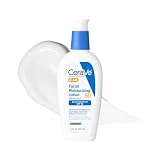
- 2. CeraVe AM Facial Moisturizing Lotion SPF 50 — Best minimal setup
- 3. La Roche-Posay Anthelios Melt-In Milk SPF 100 — Best premium
- 4. Neutrogena Ultra Sheer Liquid Mineral SPF 70 — Best upgrade
- 5. Neutrogena Ultra Sheer Dry-Touch SPF 55 — Most versatile
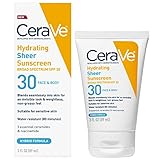
- 6. CeraVe Hydrating Sheer Sunscreen SPF 30 — Best for pros
- Mineral, chemical or hybrid: which suits dry skin?
- How long does a bottle actually last on the face?
- What the listings do not tell you about dry skin
- The verdict
- FAQ
The best drugstore face sunscreen for dry skin is Cetaphil Sheer Mineral Face Sunscreen SPF 50, a 1.7 fl oz zinc oxide formula the brand describes as microbiome-gentle and water resistant for up to 80 minutes. If you would rather buy one bottle that pulls double duty as moisturizer, CeraVe AM Facial Moisturizing Lotion SPF 50 is the better call, since its 3 fl oz formula lists ceramides, hyaluronic acid and niacinamide alongside the SPF.
Best drugstore face sunscreen for dry skin at a glance
| Pick | SPF | Filter type | Size | Price |
|---|---|---|---|---|
Best overall Cetaphil Sheer Mineral Face Sunscreen |
SPF 50 | Mineral (zinc oxide) | 1.7 fl oz | Check Price |
Best minimal setup CeraVe AM Facial Moisturizing Lotion SPF 50 |
SPF 50 | Mineral (zinc oxide) | 3 fl oz | Check Price |
Best premium La Roche-Posay Anthelios Melt-In Milk SPF 100 |
SPF 100 | Chemical | 3 fl oz | Check Price |
Best upgrade Neutrogena Ultra Sheer Liquid Mineral SPF 70 |
SPF 70 | Mineral (zinc + titanium) | 1.4 fl oz | Check Price |
Most versatile Neutrogena Ultra Sheer Dry-Touch SPF 55 |
SPF 55 | Chemical | 3 fl oz | Check Price |
Best for pros CeraVe Hydrating Sheer Sunscreen SPF 30 |
SPF 30 | Hybrid (zinc + chemical) | 3 fl oz | Check Price |



How I narrowed six drugstore SPFs to a ranked shortlist
Three cuts did most of the work. First, I dropped anything that did not name a filter type or an SPF number in its published specifications, because a dry-skin buyer needs to know whether they are getting zinc oxide, chemical filters or a blend. Second, I set aside products whose primary category is body rather than face, unless the listing explicitly names face use.
Third, I checked what each brand actually claims about hydration, since this is a dry-skin roundup and a sunscreen that leaves skin tight is a fail no matter how high the SPF number climbs.
- Six products cleared those cuts.
- Four of the six carry SPF 50 or higher.
- Three list zinc oxide, one uses zinc plus titanium, one runs chemical only, and one is a hybrid.
- Two list ceramides explicitly, and three name a hydrator by ingredient.
One caveat matters here. The listings do not label themselves "for dry skin" in a standardised way, so this is a shortlist assembled by reading each formula's own claims and matching them against what dry skin actually needs: named humectants, an emollient base, and no drying alcohol at the top of the ingredients. Treat the "dry skin" fit as your own judgement call after reading each pick, not a marketplace filter that Amazon applied for you.
Why SPF number is not the deciding specification
Most drugstore face sunscreen guides rank by SPF. That is not what decides this category for dry skin. The SPF number tells you how much UVB the filter blocks, and above SPF 30 the differences narrow sharply. What actually decides the buy is whether the base leaves your skin comfortable eight hours later.
Dry skin needs three things from a daily SPF: a filter that does not sting, humectants or emollients in the formula, and a finish that lets you apply makeup on top without flaking. Two of those are ingredient calls, not SPF calls. That is why the Cetaphil Sheer Mineral SPF 50 leads a set that includes an SPF 100 and an SPF 70. Its formula is the one whose own marketing leans hardest on "locks in moisture" language, and its filter is 100% zinc oxide, which sensitive dry skin generally tolerates without a burn.
Read the SPF number as a floor, not a ranking. Anything at SPF 30 or above clears the useful threshold for daily wear. Above that, pick on filter type, texture and what the base does for your skin barrier, in that order.
1. Cetaphil Sheer Mineral Face Sunscreen — Best overall
A 1.7 fl oz zinc oxide SPF 50 whose base is built around locking moisture in, which is what a dry-skin sunscreen has to do first.
Best for: sensitive, dry skin that reacts to chemical filters Skip it if: you want a larger bottle for face and body
Cetaphil's Sheer Mineral is the only pick in this set whose listing pairs a 100% zinc oxide filter with an explicit hydration claim. The brand describes it as microbiome-gentle and says the formula "locks in moisture to hydrate and protect skin's delicate microbiome". That marketing language is the brand's, not measured proof, but combined with a mineral-only filter it points at the right base chemistry for dry, reactive skin.
The size is the trade-off. At 1.7 fl oz this is the smallest of the six, which is fine for face-only wear but too little if you also want to share the bottle across shoulders and chest on a beach day. Cetaphil says it dries to a matte finish and wears under makeup, and the water resistance is up to 80 minutes. It is the cheapest of the six here, and it sells faster than most of this set, which is unusual for the entry price position.
Pros:
- 100% zinc oxide filter suits sensitive dry skin
- Brand claims hydration and microbiome support
- Water resistant up to 80 minutes
- Reef-friendly formula
- Cheapest of the six
Cons:
- Smallest bottle in the set at 1.7 fl oz
- Matte finish may not suit very dry cheeks
- No published ingredient list of humectants
2. CeraVe AM Facial Moisturizing Lotion SPF 50 — Best minimal setup
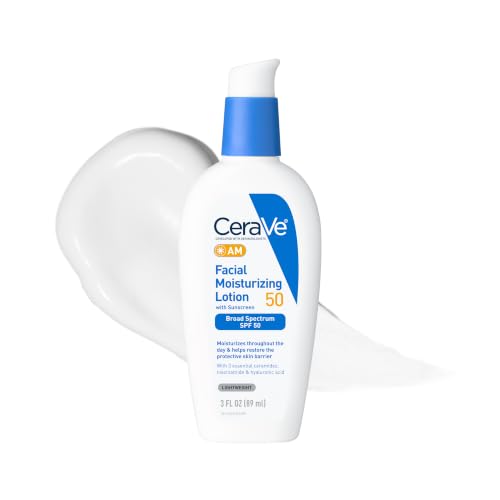
A 3 fl oz zinc oxide SPF 50 with ceramides, hyaluronic acid and niacinamide in one bottle, which is as close to a two-step morning routine as this category gets.
Best for: a two-step morning routine with moisturizer built in Skip it if: you already use a separate hydrating serum
CeraVe AM is the only pick in this set whose listing names three separate hydrators alongside the SPF. The brand lists hyaluronic acid to hold water in the skin, three essential ceramides to support the barrier, and niacinamide to calm. For dry skin, that combination in a single bottle is why this earns "best minimal setup": one product replaces both your moisturizer and your sunscreen in a morning routine.
The filter is micro-fine zinc oxide for broad-spectrum UVA and UVB. CeraVe positions it as a face moisturizer with SPF rather than a sunscreen with hydrators, which matters because the base is closer to a lotion than a sport formula. That helps if your dry patches complain about traditional SPF textures. It is priced in the middle of the six, and it is the one buyers choose most often here by a wide margin. The trade-off is that a moisturizer-first formula is not the best pick if you already use a separate serum you like, since you will end up over-layering.
Pros:
- Ceramides, hyaluronic acid and niacinamide named on the listing
- Micro-fine zinc oxide broad-spectrum SPF 50
- 3 fl oz bottle, roomier than the Cetaphil
- Replaces the moisturizer step
- The one buyers choose most often here
Cons:
- No published water resistance rating
- Redundant if you keep a dedicated moisturizer
- Not the cheapest pick in the set
3. La Roche-Posay Anthelios Melt-In Milk SPF 100 — Best premium
A 3 fl oz SPF 100 chemical sunscreen the brand positions for skin that burns easily, with 80-minute water resistance and a milk-textured base that reads as friendlier to dry skin than most SPF 100 options.

Best for: skin that burns easily and needs the highest SPF number here Skip it if: you dislike higher-priced picks in this set
La Roche-Posay's Anthelios Melt-In Milk is the highest SPF number in this roundup and the most expensive pick here. The brand specifically markets it for skin prone to burning, and the "melt-in milk" texture is where dry-skin buyers should focus, since a milk base is usually more emollient than a lotion or a gel. La Roche-Posay says it blends without leaving a white cast and wears under makeup, and the water resistance is up to 80 minutes.
The trade-off is that this is a chemical filter formula, not mineral. If your skin reacts to avobenzone or homosalate you already know it, and this is not the pick. It is also formulated for face and body, so the 3 fl oz tube goes further on a full-body application than a face-only bottle would suggest. It sells faster here than most of the set, which is unusual for the top price position. The listing notes the travel size is non-sealed.
Pros:
- SPF 100, the highest number in this set
- Milk-textured base suits dry skin
- Water resistant up to 80 minutes
- Positioned for skin that burns easily
- Face and body use extend the 3 fl oz
Cons:
- Most expensive pick here
- Chemical filters, not mineral
- Travel size ships non-sealed
4. Neutrogena Ultra Sheer Liquid Mineral SPF 70 — Best upgrade
A 1.4 fl oz zinc oxide and titanium dioxide SPF 70 with vitamin E and an eight-hour hydration claim, aimed at mineral loyalists who want a higher SPF number than most mineral options deliver.

Best for: mineral loyalists who want SPF 70 in a travel size Skip it if: you need more than 1.4 fl oz per bottle
Neutrogena's Ultra Sheer Liquid Mineral is the newest of the six, released in 2024, and its main draw is the SPF number for a 100% mineral formula. Zinc oxide and titanium dioxide sit together in the active list, and Neutrogena adds vitamin E as an antioxidant with a claim of eight-hour hydration support. For dry skin that has decided on mineral filters, this is the pick that pushes the SPF ceiling.
The size is the ceiling in the other direction. At 1.4 fl oz this is the smallest bottle in the set, and it is one of the more expensive picks here. Neutrogena calls it a travel-size format and tells you to shake for three seconds and apply "two finger lengths" per face, which is a heavier layer than most SPFs ask for and shortens how far the bottle stretches. The listing calls it fragrance-free and vegan. It is the slowest seller of the six.
Pros:
- SPF 70 with 100% mineral filters
- Vitamin E antioxidant included
- Fragrance-free and vegan formula
- Neutrogena claims eight-hour hydration
- Newest release in the set
Cons:
- Smallest bottle at 1.4 fl oz
- Two finger lengths per application shortens supply
- Slowest seller of the six here
5. Neutrogena Ultra Sheer Dry-Touch SPF 55 — Most versatile
A 3 fl oz chemical SPF 55 with vitamin E and Helioplex, positioned as a face and body sunscreen and the one to grab if you want a single bottle for everything.

Best for: one bottle you can share between face and body Skip it if: your face runs very dry and wants added hydrators
Neutrogena's Ultra Sheer Dry-Touch is the workhorse of the six. The formula uses avobenzone, homosalate, octisalate and octocrylene under the Helioplex name, and Neutrogena adds vitamin E as an antioxidant. The listing is candid that this is a face and body sunscreen, not a face-only formula, and that framing is why it earns "most versatile": if you want one bottle for morning face, weekend hikes and beach afternoons, this is it.
The trade-off for dry skin is real. The "dry-touch" finish is designed to feel non-greasy, and the base does not lean on named hydrators the way CeraVe AM does. For very dry cheeks the matte finish can read as tight later in the day, which is why this is not the overall winner. It is the second-cheapest here and it carries the standard 80-minute water resistance. Reach for it when versatility beats hydration on your priority list.
Pros:
- 3 fl oz bottle covers face and body
- Second-cheapest pick here
- Helioplex broad-spectrum chemical filter system
- Vitamin E antioxidant
- Water resistant up to 80 minutes
Cons:
- Dry-touch finish can feel tight on very dry skin
- No named hydrators in the formula
- Chemical filters may not suit sensitive skin
6. CeraVe Hydrating Sheer Sunscreen SPF 30 — Best for pros
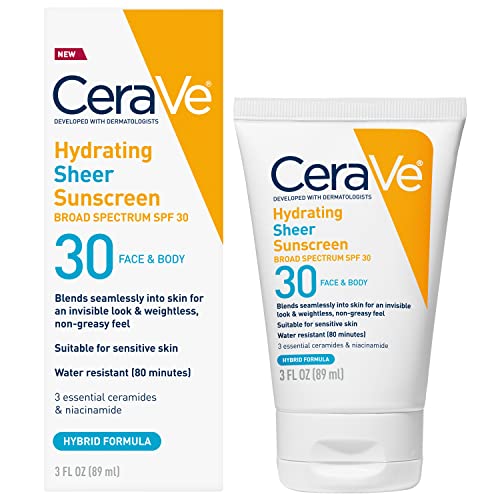
A 3 fl oz hybrid SPF 30 with zinc oxide, ceramides and hyaluronic acid, made for people who already know their routine and want a lightweight layer under makeup.
Best for: layering under makeup with a lower SPF number Skip it if: you want SPF 50 or higher
CeraVe Hydrating Sheer is the odd one out on SPF, and that is deliberate. It sits at SPF 30, the lowest of the six, and pairs a hybrid filter of zinc oxide plus chemical UV filters with the same three-ceramide barrier support CeraVe puts in its moisturizers. That combination is why it earns "best for pros": you already know you reapply through the day, you value texture over a big SPF number, and you want the sheerest possible finish under foundation.
The listing describes it as fragrance-free, paraben-free, non-comedogenic and ophthalmologist-tested. Water resistance runs up to 80 minutes. The 3 fl oz bottle sits in the middle of this set on price. The drawback is straightforward: if you spend real time outdoors, SPF 30 is a floor rather than an upgrade, and one of the SPF 50 or higher picks makes more sense. Choose this one when comfort and layering matter more than the number on the front.
Pros:
- Hybrid filter with zinc oxide and chemical actives
- Three CeraVe ceramides for barrier support
- Fragrance-free and non-comedogenic
- Water resistant up to 80 minutes
- Sheerest finish for under-makeup wear
Cons:
- Lowest SPF number in this set
- Not the pick for long outdoor days
- Hybrid filter may not suit strict mineral users
Mineral, chemical or hybrid: which suits dry skin?
Filter type is the second decision after texture, and this set gives you a clean choice across all three. Three of the six use mineral filters only, one is fully chemical, one is chemical with vitamin E, and CeraVe Hydrating Sheer is a hybrid.
- Mineral (Cetaphil, CeraVe AM, Neutrogena Ultra Sheer Liquid Mineral). Sits on top of the skin, reflects UV, generally tolerated by sensitive dry skin. The trade-off is a heavier feel and, historically, a white cast, though all three brands claim a sheer finish.
- Chemical (La Roche-Posay Anthelios, Neutrogena Ultra Sheer Dry-Touch). Absorbs into the skin and converts UV to heat. Lighter feel, easier layering under makeup, but a small share of dry, reactive skin finds the actives sting.
- Hybrid (CeraVe Hydrating Sheer). Zinc oxide with chemical filters. The idea is you get the tolerance of mineral with the texture of chemical. In practice the ceramide base is what matters most here.
For dry skin the honest answer is that texture and base ingredients decide more than filter type. A mineral formula with no humectants can feel drier than a chemical formula with hyaluronic acid. Read the actives, then read the inactives.
How long does a bottle actually last on the face?
Dermatologists recommend roughly a nickel-sized amount for the face and neck at each application. That is around a quarter to half a teaspoon. At two applications a day, five days a week, a 3 fl oz bottle covers roughly six to twelve weeks of face-only use, depending on how generous your layer is.
That maths reshapes the value picture in this set. The 1.7 fl oz Cetaphil covers roughly three to seven weeks of face-only wear. The 1.4 fl oz Neutrogena mineral covers less, especially since the listing tells you to apply "two finger lengths" per face, which is a heavier layer than a nickel-sized dot.
If you reapply properly during the day, a 3 fl oz bottle is a one-to-two month product, not a whole summer. Buy that reality into your comparison before you pick.
What the listings do not tell you about dry skin
Three things you have to judge for yourself, because the specifications will not tell you.
- Finish under makeup. Cetaphil claims matte, CeraVe AM reads as satin from the ingredient stack, La Roche-Posay claims a milk-like blend. None of that is standardised, and your foundation will tell you within a week whether the SPF is peeling under it.
- Alcohol content. Drying alcohols (SD alcohol, denatured alcohol) high in an ingredient list can undo the humectant work. The listings here do not surface the full inactive list. Check the actual carton before you commit.
- Fragrance sensitivity. Neutrogena Ultra Sheer Dry-Touch lists a "mild scent". The others lean fragrance-free. If your dry skin is also reactive, that one line matters more than any SPF number.
None of these are dealbreakers. They are the reasons to try a small size first when you can.
The verdict
Cetaphil Sheer Mineral Face Sunscreen SPF 50 is the best drugstore face sunscreen for dry skin in this set. It is the only pick that combines a 100% zinc oxide filter with the brand's explicit hydration language and the lowest price position of the six. For sensitive dry skin that reacts to chemical filters, that combination is the shortest path to a comfortable daily SPF.
Two conditions flip the recommendation. If you would rather buy one bottle that also handles your morning moisturizer, CeraVe AM Facial Moisturizing Lotion SPF 50 is the better call, because the listing names ceramides, hyaluronic acid and niacinamide alongside the SPF 50 zinc oxide filter. If your skin burns easily and you want the highest SPF number this set offers, La Roche-Posay Anthelios Melt-In Milk SPF 100 is the pick, and its milk-textured base is friendlier to dry skin than most SPF 100 formulas.
The cutoff between Cetaphil and CeraVe AM is whether you keep a separate moisturizer. Keep the moisturizer, buy Cetaphil. Drop the moisturizer, buy CeraVe AM. That is the whole decision.
FAQ
Is the best drugstore face sunscreen for dry skin actually mineral or chemical?
The best drugstore face sunscreen for dry skin in this set is mineral, specifically Cetaphil's 100% zinc oxide SPF 50, because mineral filters are generally the easier choice for sensitive, dry, reactive skin. That said, La Roche-Posay's Anthelios chemical SPF 100 places third here and works well for dry skin that tolerates chemical actives. Filter type is one factor. Base ingredients matter more.
What SPF number should I look for if my skin is dry?
What SPF number you need for dry skin starts at SPF 30 as a floor. SPF 30 blocks about 97% of UVB, and the differences narrow above that. This roundup ranges from SPF 30 (CeraVe Hydrating Sheer) to SPF 100 (La Roche-Posay Anthelios). For daily face wear, SPF 50 is the sweet spot, which is why four of these six picks land there or above.
Is CeraVe AM SPF 50 worth it over the cheaper Cetaphil?
CeraVe AM SPF 50 is worth it over the cheaper Cetaphil if you want to drop your separate morning moisturizer. The CeraVe listing names hyaluronic acid, niacinamide and three ceramides in the formula, on top of a micro-fine zinc oxide SPF 50 filter. If you already use a moisturizer you like, the Cetaphil is the smarter buy at a lower price position.
CeraVe AM SPF 50 vs Cetaphil Sheer Mineral: which for dry skin?
CeraVe AM SPF 50 vs Cetaphil Sheer Mineral comes down to whether you want a moisturizer built in. Both use zinc oxide as the filter and both are SPF 50. CeraVe adds ceramides, hyaluronic acid and niacinamide in a 3 fl oz bottle. Cetaphil is a smaller 1.7 fl oz mineral sunscreen with hydration language but no listed humectants. Choose CeraVe for the routine collapse, Cetaphil for pure SPF.
What common mistake do buyers make with dry-skin sunscreen?
The common mistake buyers make with dry-skin sunscreen is chasing the highest SPF number and ignoring the base. An SPF 100 with a drying alcohol high on the ingredient list will feel worse eight hours later than an SPF 30 with ceramides and hyaluronic acid. Read the actives, then read the inactives, then read the finish claim. SPF number is a floor, not a ranking.
The right default for dry skin, in this set, is Cetaphil Sheer Mineral SPF 50, because it does the smallest thing well: a mineral filter your face is unlikely to fight, a formula the brand builds around moisture, and the lowest price position among these six. Try one bottle before committing to a stack of three, and give it a full week under whatever moisturizer and foundation you already use. If the finish reads tight by evening, move up to CeraVe AM for the built-in ceramides. If it reads comfortable, you have just found your daily SPF for less than the price of a serum.