Best Mineral Sunscreen for Large Pores by Finish
Six mineral SPFs compared for how they sit on visible pores, from a matte tinted primer to a fragrance-free daily lotion, with the winner and the flips named.

By Corey DuncanUpdated 16 min read
On this page
- Best mineral sunscreen for large pores at a glance
- How I narrowed 30 mineral SPFs down to six
- Why zinc oxide texture is the real deciding factor
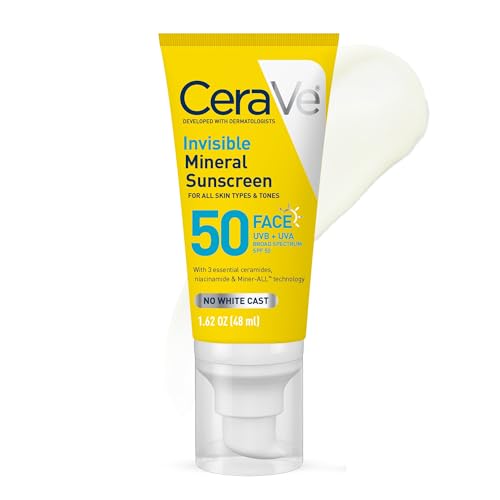
- 1. CeraVe Invisible Mineral Sunscreen SPF 50 Face Sunscreen — Best overall
- 2. Supergoop! Mattescreen Mineral Tinted Face Sunscreen SPF 40 — Best upgrade
- 3. AGE20'S UV Mineral Priming Sunscreen SPF 50+ — Most versatile
- 4. La Roche-Posay Anthelios Tinted Mineral Sunscreen for Face — Best premium
- 5. Blue Lizard Sensitive Mineral SPF 50 Sunscreen Lotion — Best for families
- 6. Cetaphil Sheer Mineral Face Sunscreen — Best budget pick
- Does a tinted mineral sunscreen actually blur pores?
- What the listings do not tell you about pore appearance
- If your skin is oily by 11 a.m., read this
- The verdict
- FAQ
The best mineral sunscreen for large pores is CeraVe Invisible Mineral Sunscreen SPF 50, a 1.62 fl oz fragrance-free zinc lotion that finishes weightless without the chalky cast that makes pores look darker. If you want a mattified, tinted finish instead, Supergoop! Mattescreen Mineral Tinted Face Sunscreen SPF 40 in its 0.68 fl oz tube is the pick, with a neutral tint designed to leave skin looking poreless.
Most guides on the best mineral sunscreen for large pores compare SPF numbers and price. That is not what decides it. Pores look bigger under a mineral SPF for one reason: the zinc-heavy film sits high on the skin and catches shadow. The picks that win here are the ones with a low-residue or mattifying finish, not the ones with the biggest number on the tube.
A note before the table: Amazon's search returned these six when I asked for mineral sunscreen suited to large pores, but only two of the six explicitly claim pore-blurring or mattifying benefits in the listing text. Treat "large pores" as a shopping consideration, not a certified feature of every bottle.
Best mineral sunscreen for large pores at a glance
| Pick | SPF & size | Finish claim | Price |
|---|---|---|---|
| SPF 50 1.62 fl oz |
100% invisible, weightless (claim) | Check Price | |
| SPF 40 0.68 fl oz |
Mattified, poreless-looking (claim) | Check Price | |
Most versatile AGE20'S UV Mineral Priming Sunscreen SPF 50+ |
SPF 50+ 1.69 fl oz |
Blurs pores, primes makeup (claim) | Check Price |
| SPF 50 1.7 fl oz |
Tinted matte finish (claim) | Check Price | |
Best for families Blue Lizard Sensitive Mineral SPF 50 Sunscreen Lotion |
SPF 50 5 fl oz |
Hydrating, no explicit finish | Check Price |
Best budget pick Cetaphil Sheer Mineral Face Sunscreen |
SPF 50 1.7 fl oz |
Dry matte finish (claim) | Check Price |


How I narrowed 30 mineral SPFs down to six
I started with roughly thirty mineral face sunscreens that turned up under this search, then cut hard on three criteria.
- Any product without a clearly listed zinc oxide or titanium dioxide active ingredient came out. Mineral is the whole premise.
- Any product whose listing led with a heavy, cream-based or "rich" texture came out. On skin with visible pores, that finish is exactly the problem.
- Any product without a stated face use came out. Body-first formulas sit thicker.
That left the six above. Three of them (Supergoop! Mattescreen, AGE20'S, Cetaphil Sheer) explicitly promise a matte, blurring or poreless-looking finish in their listing text. Two (CeraVe Invisible Mineral, La Roche-Posay Anthelios) promise invisible or subtle-tint finishes without using the word pore. Blue Lizard Sensitive sits in the set because a lot of readers want one bottle for face and body, and its 5 fl oz size and sensitive formula earn it a place, even though the listing does not mention pores at all.
Two picks share the entry price position, two share the mid, two share the premium. That spread lets me recommend across budgets without pretending a costlier bottle automatically finishes finer.
Why zinc oxide texture is the real deciding factor
Mineral sunscreens work by sitting on top of the skin as a physical film. On a pore, that film pools at the rim and casts a tiny shadow, which reads as a bigger, darker pore. That is why SPF number is almost irrelevant here: a well-formulated SPF 40 can look smoother than a poorly formulated SPF 50.
Two things move the needle. First, how sheer the mineral film dries down. CeraVe calls their approach Miner-ALL technology and promises a 100% invisible finish; that is a manufacturer claim, but the phrasing is aimed exactly at this problem. Second, whether the formula includes a mattifying or blurring component. Supergoop! Mattescreen is oil-free with a neutral tint pitched at a poreless look. AGE20'S is sold as a priming sunscreen that blurs pores and uneven texture.
- Look for zinc oxide as the sole or primary active if you want the cleanest single-mineral finish.
- Look for "matte", "blurring", "priming" or "poreless" in the listing text if pore appearance is the whole reason you are shopping.
- Skip anything that leads with words like "rich", "nourishing" or "cream" unless your skin is dry as well as porous.
1. CeraVe Invisible Mineral Sunscreen SPF 50 Face Sunscreen — Best overall
A fragrance-free daily mineral SPF that stays invisible on skin, which is exactly what visible pores need.
Best for: combination skin that wants a clear, weightless daily SPF Skip it if: you need a tinted finish or built-in mattifying primer
CeraVe wins the top slot because it does the one thing that matters most on porous skin: it dries down without a chalky film. The 1.62 fl oz tube is fragrance-free, non-comedogenic and, per CeraVe, formulated with three essential ceramides and their Miner-ALL technology for a 100% invisible finish. Those are the brand's claims, but the ceramide angle matters here because dry, tight skin around pores makes them look deeper, and a mineral SPF that also hydrates avoids that trap. Released in 2025, it is the newest formula in this set, which suggests a modern zinc dispersion rather than the older, whiter mineral textures.
Weight-wise it lands at 2.88 oz on the listing, in the standard flip-cap tube shape (5.51 x 1.43 x 1.86 in). It is the second-cheapest of the six. Its trade-off against Supergoop! and AGE20'S is that it makes no pore-blurring claim. This is an invisible finish, not a mattifying one, so if your skin is very oily by lunchtime you will still want a powder over the top.
Pros:
- Fragrance-free and suitable for sensitive, acne-prone skin
- Claims a 100% invisible finish across skin tones
- Ceramide-backed formula for skin barrier support
- Non-comedogenic per the listing
- Entry price position in this set
Cons:
- No tint option if you want extra evening-out
- No explicit mattifying or pore-blurring claim
- Newer 2025 formula with less long-term listing history
2. Supergoop! Mattescreen Mineral Tinted Face Sunscreen SPF 40 — Best upgrade
The only pick here whose listing explicitly promises a poreless-looking, mattified finish.

Best for: oily skin chasing a mattified, poreless-looking finish Skip it if: you dislike tinted formulas or want SPF 50
If pore appearance is the entire reason you are here, this is the formula the language of the listing was written for. Supergoop! describes Mattescreen as an oil-free zinc oxide sunscreen with a neutral tint that leaves skin looking "mattified and poreless" at broad-spectrum SPF 40. The tube is smaller than the rest of the set, 0.68 fl oz, and shaped flatter (1.43 x 3.68 x 0.91 in) than the standard rounds. That size makes it a top-up tube, not a family bottle.
It is one of two picks in the premium price position, and it is also the only formula here that combines a tint, a matte finish and a zinc oxide active. Its trade-off is real: SPF 40 is a step below the SPF 50 the other five carry. For daily indoor-to-outdoor use that gap is minor; for a beach day, it is not the pick. It also comes in a limited shade range, so darker skin tones may want to pair it with an untinted layer or check the shade match carefully. Sales-wise it moves less quickly here than the drugstore names, which reflects its price position more than its formula.
Pros:
- Only pick that explicitly claims a poreless-looking finish
- Oil-free with a neutral tint for even skin appearance
- Zinc oxide active in a mattifying formula
- Compact tube fits a handbag
- Oxybenzone- and octinoxate-free
Cons:
- SPF 40 rather than SPF 50
- Smallest tube of the six at 0.68 fl oz
- Tinted only, in a limited shade range
- Premium price position
3. AGE20'S UV Mineral Priming Sunscreen SPF 50+ — Most versatile
A mineral SPF sold as a pore-blurring primer, so it earns its keep whether you wear makeup or not.

Best for: makeup wearers who want SPF and a pore-blurring primer in one step Skip it if: you want a widely stocked brand with a long track record
AGE20'S sits in an unusual spot: an SPF 50+ mineral sunscreen sold as a primer, with the listing promising that it "blurs the look of pores and uneven texture" so foundation applies more evenly. The 1.69 fl oz tube weighs 1.76 oz and comes in a slim shape (6.22 x 1.81 x 0.91 in) that suits a makeup bag. It is a Korean-formulated vegan sunscreen, per the brand, with a lightweight, non-greasy texture designed for layering.
The pore-blurring claim is the whole reason this made the list. If it delivers even half of that on your skin, it is doing the exact job the search implies. Its trade-offs are two-fold. It is the slowest seller of the six here, which means less user familiarity and fewer independent reference points. And the brand is less established in the US market than CeraVe or La Roche-Posay, so restocking may vary by seller. It sits in the mid price position, and it is the only pick that combines an SPF above 50 with an explicit pore-focus.
Pros:
- SPF 50+ mineral protection
- Explicit pore-blurring, primer-style claim
- Lightweight, non-greasy texture per the listing
- Vegan formula
- Slim tube shape for makeup bags
Cons:
- Slowest-moving pick in this set
- Less-established brand in the US market
- Fewer published skin-type notes on the listing
- No stated warranty or return specifics
4. La Roche-Posay Anthelios Tinted Mineral Sunscreen for Face — Best premium
A dermatologist-tested tinted mineral SPF whose subtle tint does much of the pore-evening work.

Best for: sensitive skin that wants a subtle tint and dermatologist-tested formula Skip it if: you prefer an untinted, budget-friendly option
Anthelios Tinted Mineral is the pick if you want the safety-net of a long-established brand and a light tint that softens pore contrast without looking like foundation. The 1.7 fl oz tube weighs 1.8 oz and is the most compact of the standard-size options (5.5 x 1.92 x 0.94 in). La Roche-Posay describes it as a 100% mineral sunscreen with titanium dioxide, their Cell-Ox Shield technology and a fast-absorbing, blendable texture that leaves a tinted matte finish. The listing lists a Skin Cancer Foundation recommendation and Allure Best of Beauty recognition, in the brand's own words.
Two things make this the premium pick rather than the overall winner. It is titanium-dioxide-based rather than zinc, which some porous, oil-prone skin tolerates less well than pure zinc formulas. And it is the most expensive pick here. In return, you get a formula that has been on shelves since 2015, four available shades, and a matte-finish tint that levels out both pore shadow and redness in one step. If your budget is flexible and your skin is sensitive, this is the pick that gives you the most safety margin.
Pros:
- 100% mineral with titanium dioxide
- Subtle tint that evens skin appearance
- Available in four shades per the listing
- Dermatologist-tested per the brand
- Long-running formula in the market
Cons:
- Most expensive pick in this set
- Titanium dioxide rather than pure zinc
- Tint may not suit the darkest skin tones without adjustment
- Matte finish is subtle, not high-mattifying
5. Blue Lizard Sensitive Mineral SPF 50 Sunscreen Lotion — Best for families
One bottle for face and body, sized for a household rather than a handbag.

Best for: sharing one bottle between face and body on beach days Skip it if: you want a face-only formula sized for a handbag
Blue Lizard is the odd one out and it earns its place on volume. The 5 fl oz bottle is nearly three times the size of the face-only tubes, at 5 oz weight and 7.75 x 5.5 x 1.5 in on the listing, which is why one bottle can cover a family day out. It is a 100% mineral, water-resistant SPF 50, hypoallergenic, paraben-free, fragrance-free and infused with organic aloe vera. Blue Lizard states the formula is reef-friendly, without oxybenzone or octinoxate.
For visible pores, this is a compromise pick. The listing makes no mattifying or blurring claim, and the texture is closer to a traditional lotion than a face-first sheer sunscreen. What it offers instead is a sensitive-skin formula in a size that lets you top up throughout the day without rationing. It is the one buyers choose most often in this set, judging by how it moves on Amazon. It sits at the mid price position. The trade-off against the face-only picks is honest: better as an all-day, everywhere SPF than as a pore-refining daily.
Pros:
- 5 fl oz size covers face and body
- Water-resistant SPF 50
- Fragrance-free, paraben-free, hypoallergenic per the listing
- Aloe vera in the formula
- Sells faster than the rest of this set
Cons:
- No mattifying or pore-blurring claim
- Bulkier bottle than the handbag-size picks
- Lotion texture is heavier than sheer face SPFs
- Body-first design, not face-first
6. Cetaphil Sheer Mineral Face Sunscreen — Best budget pick
A fragrance-free zinc-oxide face SPF at the cheapest position here, with a stated matte finish.

Best for: a no-frills daily mineral SPF that layers under makeup Skip it if: you want a tinted or explicitly mattifying finish
Cetaphil Sheer Mineral is the cheapest of the six and is set up as a straightforward daily zinc-oxide SPF 50 for the face. The 1.7 fl oz tube (5.47 x 1.68 x 2.36 in, 2.45 oz) is water-resistant to 80 minutes and, per Cetaphil, leaves a dry matte finish for use alone or under makeup. The listing describes a microbiome-gentle, non-comedogenic, ultra-lightweight formula that is dermatologist and ophthalmologist tested.
Its case for porous skin is the matte-finish claim plus the price. What it lacks is any tint and any explicit pore-blurring language. Compared with CeraVe, it is a step older (2021 release) and does not mention ceramides. Compared with Supergoop! Mattescreen, it is far cheaper but its matte claim is more modest, closer to "not shiny" than to "poreless". The trade-off is real: at the entry price position you get a solid, no-drama zinc SPF, but you are not paying for the specialised pore-focused chemistry that AGE20'S and Supergoop! promise.
Pros:
- Cheapest pick in this set
- Zinc oxide active
- Water-resistant to 80 minutes per the listing
- Dry matte finish claim
- Fragrance- and paraben-free
Cons:
- No tint option
- Matte claim is modest rather than mattifying
- No pore-focused language on the listing
- Older 2021 formula than CeraVe's 2025 update
Does a tinted mineral sunscreen actually blur pores?
A tint does not physically fill a pore, but it does two useful things. It reduces the contrast between the pore opening and the surrounding skin, and it adds a light-diffusing pigment layer over the mineral film. Both cut the visible shadow that makes pores look big.
Of the six picks, three carry a tint of some kind: La Roche-Posay Anthelios (four shades), Supergoop! Mattescreen (three tinted shades plus one universal) and, to a lesser extent, AGE20'S with its priming finish. If you have visible pores and no makeup routine, a tinted mineral SPF often outperforms a heavier foundation, because the film stays thinner. The catch is shade matching. A wrong-shade tint sits on the skin the same way a chalky white cast does, only in a different colour.
- Match the tint to your jaw, not your cheek.
- Test the tint on the side of your neck, not your forearm.
- Layer it thin. Two thin passes look better than one heavy one on porous skin.
What the listings do not tell you about pore appearance
Listing text is written to sell, so a few pore-relevant things stay off it. First, pore appearance shifts through the day: on oily skin, sebum builds up in the pore rim and darkens it by mid-afternoon. A morning application that looked flawless at 9 a.m. can look grainy by 3 p.m., which is a top-up problem, not a formula failure.
Second, mineral SPFs settle into fine lines and pores when applied over too many hydrating layers. If you are stacking serum, essence, moisturiser and SPF, the last layer has nowhere to sit but on top. Cutting one hydrating step often improves how a mineral SPF looks on porous skin more than switching the SPF itself.
Third, the physical act of application matters. Pressing the SPF in with a damp sponge or clean fingertips leaves a thinner, more even film than rubbing it in with dry hands. That single change often does more for pore appearance than moving between two similar formulas.
If your skin is oily by 11 a.m., read this
Very oily skin plus visible pores is the hardest combination for a mineral SPF, because the same oil that enlarges the pore also breaks down the sunscreen film. Two things help.
- Choose a formula that is oil-free and explicitly matte. In this set, Supergoop! Mattescreen and Cetaphil Sheer are the two that lean matte in their listing text. AGE20'S adds the primer angle.
- Top up with a mineral SPF powder over the top, not with more lotion. Powder absorbs the oil that is causing the pore contrast without adding thickness.
Skip this route if your skin is dry as well as porous. On dry skin, a mattifying SPF exaggerates texture rather than smoothing it, and a ceramide-supported formula like CeraVe's Invisible Mineral will read as smoother, even without a matte claim.
The verdict
If your skin is normal to combination and you want one mineral sunscreen that behaves well on visible pores, CeraVe Invisible Mineral Sunscreen SPF 50 is the default. It is fragrance-free, non-comedogenic, ceramide-supported and promises an invisible finish, and it sits at the entry price position, so the risk of trying it is low.
If your skin is oily and you want a mattified, tinted finish that leans hard into a poreless-looking result, Supergoop! Mattescreen Mineral Tinted Face Sunscreen SPF 40 is the pick. The cutoff between the two is straightforward: if you find yourself blotting your T-zone before lunch, choose Supergoop!. If you do not, choose CeraVe.
Two other flips are worth naming. If you want a tinted SPF from a dermatologist-forward brand and price is not the constraint, La Roche-Posay Anthelios Tinted Mineral is the premium pick. If you want one bottle to share with the household, Blue Lizard Sensitive at 5 fl oz is the sane choice, even though it makes no pore claim. AGE20'S is the wildcard for makeup wearers who want SPF and primer combined, and Cetaphil Sheer is the safety-net entry option.
FAQ
Is a mineral sunscreen actually better than a chemical one for large pores?
A mineral sunscreen is not automatically better for large pores, and this is worth being honest about. Chemical SPFs often sit thinner on skin, which can look smoother. Mineral wins on sensitivity and on formulas explicitly designed with a matte or blurring finish, like Supergoop! Mattescreen and AGE20'S UV Mineral Priming Sunscreen. Choose mineral when your skin reacts to chemical filters or when you specifically want a mattified look.
Does SPF 50 look thicker on pores than SPF 40?
Whether SPF 50 looks thicker on pores than SPF 40 depends on the formula, not the number. Higher SPF often means more active ingredient, and in a mineral sunscreen that can mean more zinc or titanium sitting on the skin. But CeraVe Invisible Mineral at SPF 50 is engineered for an invisible finish, while Supergoop! Mattescreen at SPF 40 is engineered for a matte one. Read the finish claim, not the number.
Should I pick CeraVe Invisible Mineral or Supergoop! Mattescreen?
Pick CeraVe Invisible Mineral if your skin is normal to combination, you dislike tinted products, and you want a fragrance-free daily SPF at an entry price. Pick Supergoop! Mattescreen if your skin is oily, you want a tinted, mattified finish that promises a poreless look, and you are comfortable with SPF 40 rather than SPF 50. The tint and the matte finish are what you are paying the premium for.
Is a tinted mineral sunscreen worth it for visible pores?
A tinted mineral sunscreen is worth it for visible pores if you would otherwise reach for foundation to even things out. The tint reduces contrast between pore openings and surrounding skin, which is often what makes pores look bigger. La Roche-Posay Anthelios Tinted Mineral offers four shades, and Supergoop! Mattescreen offers three tinted plus one untinted. Match the tint to your jawline, apply thinly, and skip foundation on top.
Can I use a body sunscreen like Blue Lizard on my face?
Yes, you can use a body sunscreen like Blue Lizard Sensitive on your face, and many people do. The formula is 100% mineral, fragrance-free and hypoallergenic per the listing, so it is unlikely to irritate. The trade-off is finish: at 5 fl oz it is a body-first lotion, and it makes no mattifying or pore-blurring claim. Face-first tubes like CeraVe or Cetaphil Sheer will usually look smoother on visible pores.
Start with CeraVe Invisible Mineral Sunscreen SPF 50 as the default, use one thin layer pressed in with clean fingertips, and give it two weeks of daily wear before you decide. Two weeks is long enough to see how it behaves through a full range of weather, oil cycles and makeup combinations, which a single trial morning will not show you. If it disappears cleanly on your skin, you have solved the problem at the cheapest end of the set. If it does not, you now know exactly why, and the flip to Supergoop! Mattescreen or a tinted Anthelios becomes an informed choice rather than a guess.